[ad_1]
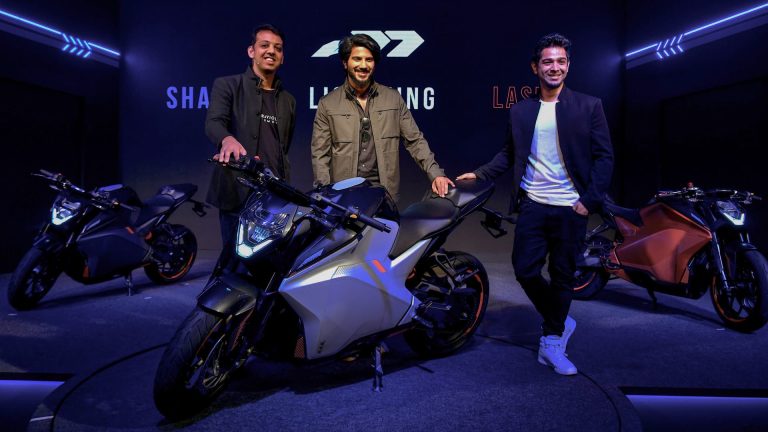
Bollywood actor and promoter of the startup Ultraviolette Automotive Personal Restricted, Dulquer Salmaan (C) together with the founders, Chief Govt Officer Narayan Subramaniam (R) and Chief Expertise Officer Niraj Rajmohan pose for {a photograph} throughout the unveiling of F77, India’s first excessive efficiency electrical motorbike designed and developed by the corporate, in Bangalore on November 13, 2019.
Manjunath Kiran | AFP | Getty Photos
When most individuals take into consideration electrical autos, they assume automobiles.
From manufacturers like Tesla and Rivian in america, to Nio and XPeng in China, world gross sales of electrical autos have surged. Two million EVs had been bought in simply the primary quarter of 2022 — that is a big soar from a decade in the past when gross sales hit solely 120,000 automobiles worldwide, the International Energy Agency reported.
India’s completely different. The US and China have centered on the adoption of EV automobiles. However in India, the world’s fifth-largest financial system, two-wheel autos equivalent to scooters, mopeds and motorbikes, dominate the market.
James Hong, head of mobility analysis at Macquarie Group, stated two-wheel autos are in increased demand than automobiles in India, and that should not come as a shock.
Underdeveloped street infrastructure and decrease private incomes make it extra handy and reasonably priced for individuals to personal scooters, motorbikes or mopeds, slightly than automobiles, Hong stated.
Nonetheless, adoption stays low.

EVs make up solely round 2% of complete vehicle gross sales, however the Indian authorities has formidable targets to extend EV adoption within the subsequent decade, specializing in elevating purchases of two-wheel autos.
Gross sales in India are anticipated to rise by between 40% and 45% by 2030, at which level 13 million new autos shall be bought yearly, in line with projections from Bain & Company printed in December.
India’s four-wheel car sector is poised to develop by solely 15% to twenty% by 2030, with 1 million new autos bought yearly, the consulting agency stated.
Development of India’s four-wheel EV section is predicted to be smaller as a result of the automobiles are largely owned solely by drivers who journey out of town on longer routes, stated Arun Agarwal, deputy vice chairman of fairness analysis at Kotak Securities.
Bain & Co. predicts that complete income throughout the complete provide chain of India’s EV trade will generate $76 billion to $100 billion by 2030.
Decreasing price to extend adoption
Folks in India have lengthy most popular two wheels to 4, and the nation is house to greater than 10 startups serving the market, Agarwal stated.
For India to extend purchases of two-wheel autos, they should be cheaper, and extra charging infrastructure must be in place, Jinesh Gandhi, fairness analysis analyst at Motilal Oswal Securities, informed CNBC.
Gandhi stated that 90% of two-wheel autos with inside combustion engines price between 70,000 rupees ($845) and 140,000 rupees ($1,690). The beginning value of electrical two-wheel autos could be as excessive as 160,000 rupees.
The price of EVs will come down if battery costs drop, Kotak’s Agarwal stated.
Excessive inflation and disrupted provide chains have pushed batter costs increased in 2022, Bain & Co. stated. The price must fall by a further 20% to 30% for EVs to compete with inside combustion engine autos.
Arun Kumar, chief monetary officer of two-wheel EV producer Ola Electrical, stated it is a “fable” that EVs are costlier than inside combustion autos as a result of the “lifecycle price of possession of an EV is decrease” than a two- or four-wheel car that runs on gas.
Ola Electrical’s two-wheel scooters, and upcoming bike and four-wheel passenger automobile, all vary between $1,000 and $50,000.
Ola Electrical
Which means the amount of cash EV homeowners can save in gas and upkeep prices can offset the upper preliminary buy value, he stated.
Ola’s two-wheel scooters, an upcoming bike, and four-wheel passenger automobile vary between $1,000 and $50,000, he stated.
“There isn’t any coming again to [internal combustion engine] autos. It is a single path,” Kumar added.
Authorities assist
Central and state governments in India have been offering incentives to encourage customers in India to make the change to EVs, Kotak’s Agarwal stated.
In accordance with the International Energy Agency, authorities applications have supplied funding to ramp up manufacturing of EV public buses and taxis, in addition to improve charging stations round India.
EV homeowners are additionally granted street tax exemption on the time of buy, and can obtain a deduction on their earnings tax, the Accelerated e-Mobility Revolution for India’s Transportation stated.
Together with taxes, homeowners of two-wheel inside combustion engine autos in India usually pay 3,000 rupees a month for his or her car, Kumar stated. Authorities initiatives coupled with cash saved on petrol would due to this fact imply that the month-to-month installment on a car turns into largely free to a buyer, he stated.
‘Vary anxiousness’
Because the adoption of electrical autos is ready to extend, so will charging infrastructures across the nation. That continues to be an element deterring individuals from making the change away from carbon-intensive autos, Kotak’s Agarwal stated.
“If you’re stranded on the street, you have no possibility however to get the car towed to the closest charging station, which is time- in addition to a cost-consuming,” Gandhi stated.
India’s charging infrastructure might want to considerably increase to help the variety of EV corporations which can be set to return on the roads, the Bain & Co. report stated, noting that a number of corporations have made early investments and are dedicated to rising the supply of chargers.
Tata Energy claimed that it has constructed about 2,500 charging stations over 300 cities and cities in India.
Tata Energy
One in every of them is Tata Power, India’s largest privately owned energy technology firm.
Tata Energy claimed it has constructed about 2,500 charging stations in 300 cities and cities in India. They are often discovered on 350 of 600 highways within the nation, stated Virendra Goyal, the agency’s head of enterprise growth.
Many EV homeowners endure from “vary anxiousness” when the gap between charging stations is simply too far, and bridging the hole would encourage extra drivers emigrate to e-mobility, he stated.
The corporate goals to have 25,000 chargers throughout India by 2028, Goyal stated.
Correction: This text has been up to date to precisely report the place India ranks among the many world’s largest economies. An earlier model misstated its rating.
[ad_2]
Source link