[ad_1]
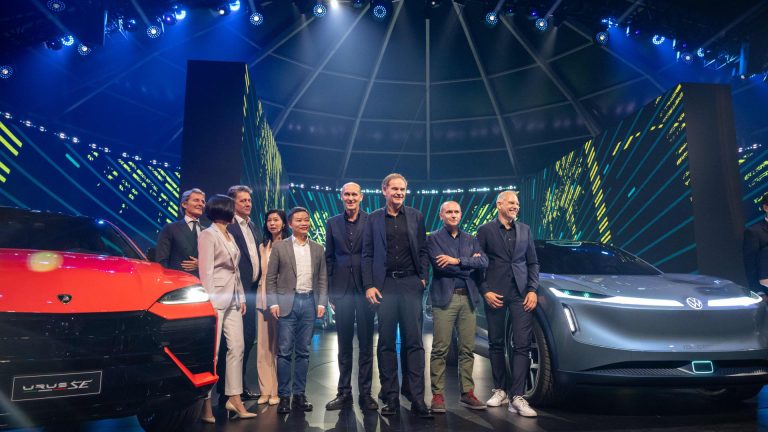
High Volkswagen and Xpeng executives pose on the German automaker’s launch occasion in Beijing, China, on Aug. 24, 2024.
Bloomberg | Bloomberg | Getty Photographs
BEIJING — A whole lot of Volkswagen workers are spending time at Xpeng because the German auto large and Chinese language startup work to create electrical automobiles for China, Xpeng co-president Brian Gu advised CNBC on Monday.
He additionally stated the partnership will assist Xpeng’s world ambitions.
Volkswagen in July 2023 introduced a $700 million investment into Xpeng to collectively develop two electrical automobiles for supply in China in 2026. The autos can be based mostly on the platform for Xpeng’s G9, a midsize electrical crossover SUV.
The German firm’s employees are spending extra time at Xpeng’s workplaces than the startup’s are at Volkswagen’s, Gu stated. They’re studying concerning the startup’s technology.
Xpeng’s driver-assist technology is broadly thought-about top-of-the-line at present accessible in China. Tesla’s model, marketed as “full self-driving,” is not absolutely accessible in China.
The German automaker didn’t instantly reply to a request for remark.

Gu emphasised the forthcoming autos can be “very totally different” from those who at present bought by Xpeng or Volkswagen. He stated the automobiles would possible have “higher vary, charging, a lot smarter driving, extra characteristic luxurious expertise, for a similar value, probably.”
China is a key marketplace for Volkswagen. The German automaker delivered 3.2 million cars in China last year, greater than the three.1 million in all of Western Europe.
However like many conventional international auto giants, Volkswagen has also struggled in China because the native market quickly shifts in direction of battery-only and hybrid powered autos. The corporate’s China deliveries plunged by 19.3% within the quarter ended June from a yr in the past.
Whereas Xpeng noticed second-quarter deliveries develop by 30% year-on-year to greater than 30,200 autos, the startup lags behind a lot of its Chinese language rivals.
Wanting abroad
The corporate has, in the meantime, pushed overseas, as have Chinese language electrical automobile firms BYD and Nio. Within the second quarter, Xpeng stated its abroad gross sales exceeded 10% of whole income for the primary time.
Xpeng CEO and Founder He Xiaopeng advised Bloomberg final week that the Chinese language automaker is in preliminary phases of selecting a site in the European Union as a part of future plans for localizing manufacturing. The interview was revealed Tuesday.
Requested for remark, Xpeng stated it shared throughout the Beijing auto present within the spring that the corporate is contemplating the opportunity of abroad manufacturing.
Gu individually advised reporters Monday that localization efforts in Southeast Asia would possible occur sooner than any in Europe.
He stated the 10-year-old startup goals to achieve not less than 40 international locations and areas by the tip of this yr, up from round 30 to this point.
Xpeng launched in Thailand, Hong Kong and Macao earlier this month. Gu stated that this week, the startup is launching in Malaysia, and formally unveiling its entry into Singapore, the place Xpeng has a pop-up retailer.
The startup additionally plans to enter Australia, New Zealand, the U.Ok. and Eire, Gu stated.
Provide chain partnership
Talking on how the Chinese language firm is studying from its German accomplice, Gu stated that Xpeng workers go to Volkswagen workplaces within the metropolis of Hefei, the capital of China’s Anhui Province, for design and expertise, and Beijing for provide chain discussions.
The 2 firms in February introduced that that they had entered a “joint sourcing program” for auto components.
Xpeng has invested in robotics since 2020 and is now targeted on humanlike robots that may deal with a number of duties in factories, Gu advised CNBC. He indicated Xpeng would possible reveal extra particulars quickly.
However when requested whether or not that humanoid integration included Volkswagen-related provide chains, he stated it was too early for such implementation.
— CNBC’s Sonia Heng contributed to this report.
[ad_2]
Source link