[ad_1]
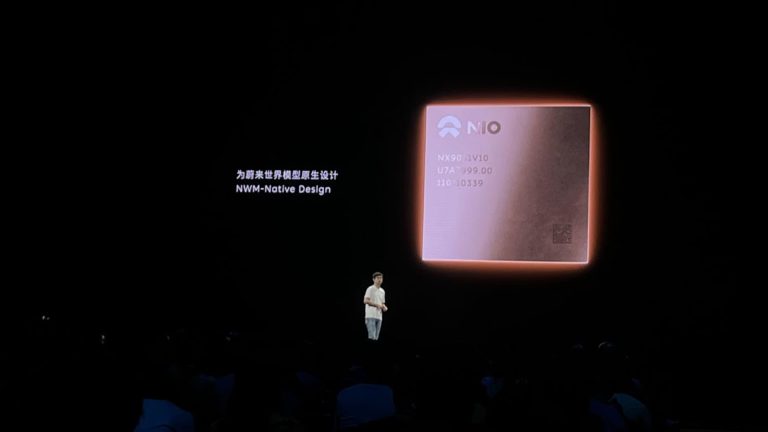
Shaoqing Ren, vp, autonomous driving growth, at Nio speaks concerning the electrical firm’s 5nm chip at its tech day in Shanghai on July 27, 2024.
CNBC | Evelyn Cheng
BEIJING — Chinese language electrical automotive firms which might be already engaged in an intense worth warfare are turning up the warmth on one other entrance: Chip-powered tech options such because the driver-assist operate.
Nio and Xpeng have introduced that their in-house designed auto chips are prepared for manufacturing. Thus far, most of the main Chinese language electrical automotive makers have relied on Nvidia chips, with the corporate’s automotive chips enterprise over the previous few years bringing in additional than $300 million in income 1 / 4.
“It is arduous to level to your product being superior when your opponents use the very same silicon to energy their infotainment and clever driving techniques,” mentioned Tu Le, founding father of consulting agency Sino Auto Insights, explaining why EV makers are turning to in-house chips.
Le mentioned he anticipated Tesla and Chinese language electrical automotive startups to compete on designing their very own chips, whereas conventional automakers will doubtless nonetheless depend on Nvidia and Qualcomm “for the foreseeable future.”
Nvidia reported a 37% year-on-year enhance in automotive section income to $346 million within the newest quarter.
“Automotive was a key progress driver for the quarter as each auto maker creating autonomous automobile know-how is utilizing NVIDIA of their Information Facilities,” firm administration mentioned on an earnings name, in accordance with a FactSet transcript.

“I feel the primary cause why Chinese language [automakers] concentrate [to] self-development system-on-chip is the success of Tesla in full-self driving,” mentioned Alvin Liu, a Shanghai-based senior analyst for Canalys.
In 2019, Tesla reportedly shifted from Nvidia to its own chip for superior driver-assist capabilities.
By designing their very own chips, Chinese language automakers can customise options, in addition to cut back provide chain threat from geopolitical tensions, Liu mentioned.
Liu doesn’t anticipate vital impression to Nvidia within the short-term, nonetheless, as Chinese language automakers will doubtless check new tech in small batches within the higher-end of the market.
Leveraging newest tech
Nio in late July mentioned it had finished designing an automotive-grade chip, the NX9031, that makes use of a extremely superior 5 nanometer manufacturing know-how.
“It’s the first time that the five-nanometer course of know-how has been used within the Chinese language automotive business,” mentioned Florence Zhang, consulting director at China Insights Consultancy, in accordance with a CNBC translation of her Mandarin-language remarks. “It has damaged by way of the bottleneck of home clever driving chip analysis and growth.”
Nio, which had teased the chip in December, plans to make use of it within the high-end ET9 sedan, set for supply in 2025.
The 5 nanometers know-how is probably the most superior one for autos as a result of the three nanometer tech is generally used for smartphone, private laptop and synthetic intelligence-related purposes, CLSA analyst Jason Tsang, mentioned following the Nio chip announcement.
Xpeng at its occasion on Tuesday didn’t disclose the nanometer know-how it was utilizing for its Turing chip. The corporate‘s driver-assist technology is extensively thought-about the most effective presently accessible in China.
Whereas Xpeng revealed its chip on Tuesday, Brian Gu, Xpeng president, emphasised in a CNBC interview the day earlier than that his firm will primarily companion with Nvidia for chips.
The 2 firms have an in depth relationship, and Xpeng’s former head of autonomous driving joined Nvidia last year.
Giants in China’s electrical automotive business are additionally recognizing the significance of chips for autos.
If batteries had been the inspiration for the primary section of electrical automotive growth, semiconductors are the idea for the business’s second section, because it focuses on sensible linked autos, BYD‘s founder, Wang Chuanfu, mentioned in April at a press convention held by Chinese language driver-assist chip company Horizon Robotics.
Wang mentioned greater than 1 million BYD autos use Horizon Robotics chips.
BYD on Tuesday introduced its Fang Cheng Bao off-road vehicle brand would use Huawei’s driver-assist system.
U.S. restrictions on Nvidia chip gross sales to China haven’t directly affected automakers for the reason that automobiles have not required probably the most superior semiconductor know-how to date.
However with rising concentrate on driver-assist tech, which depends extra on synthetic intelligence — a section on the heart of U.S.-China tech competitors — Chinese language automakers are turning to in-house tech.
Waiting for the subsequent decade, Xpeng Founder He Xiaopeng mentioned Tuesday the corporate plans to turn into a worldwide synthetic intelligence automotive firm.
When requested concerning the availability of computing energy for coaching driver-assist tech, Xpeng’s Gu informed reporters Monday that previous to the U.S. restrictions the corporate had been working with Alibaba Cloud. He claimed that entry now in all probability provides Xpeng the most important cloud computing capability amongst all automotive producers in China.
Creating new tech and requirements
Authorities incentives, from subsidies to help for constructing out a battery charging community, have helped electrical automobiles take off in China, the world’s largest auto market.
In July, penetration of recent vitality autos, which incorporates battery-only and hybrid-powered automobiles, exceeded 50% of recent passenger automobiles offered in China for the primary time, in accordance with business information.
That scale implies that firms concerned within the nation’s electrical automotive growth are additionally contributing to new requirements on tech for automobiles, resembling eradicating the necessity for a bodily key to unlock the door. As an alternative, drivers can use a smartphone app.
How that app or gadget securely connects drivers to their automobiles is a part of the forthcoming set of requirements that the California-based Automotive Connectivity Consortium is engaged on, in accordance with president Alysia Johnson.
1 / 4 of the group’s members are based mostly in China, together with Nio, BYD, Zeekr and Huawei. Apple, Google and Samsung are additionally members, Johnson revealed.
She mentioned the group is seeking to allow a driver of a Nio automotive that makes use of a Huawei telephone to securely ship the automotive “key” to a companion who makes use of an Apple telephone and drives a Zeekr automotive, for instance.
“Digital key tech is changing into much more accessible than individuals would assume,” she mentioned.
[ad_2]
Source link