[ad_1]
The Volvo brand is displayed on the Volvo Automobiles Hill Nation dealership on September 04, 2024 in Austin, Texas.
Brandon Bell | Getty Photos Information | Getty Photos
European automotive giants are contending with an ideal storm of challenges on the trail to full electrification, together with an absence of reasonably priced fashions, a slower-than-anticipated rollout of charging factors and the potential impact of European tariffs on EVs made in China.
Volvo Cars on Wednesday announced it had deserted its closely promoted plan to promote solely EVs by 2030, citing a must be “pragmatic and versatile” amid altering market circumstances.
The Swedish automaker said it now goals for between 90% and 100% of its automotive gross sales to be absolutely electrical or plug-in hybrid fashions by 2030. The corporate now says that as much as 10% of its gross sales will signify a restricted variety of delicate hybrid fashions by that deadline.
Crisis-stricken Volkswagen and several other different carmakers, together with Ford and Mercedes-Benz Group, have all announced plans to delay earlier targets to part out gross sales of inside combustion engines autos in Europe.
“I believe a variety of producers are clearly going by way of this course of [of delaying electrification targets] in the intervening time. We’re seeing it throughout the trade,” Tim Urquhart, principal automotive analyst at S&P International Mobility, instructed CNBC’s “Squawk Field Europe” on Monday.
“A whole lot of producers who had type of stopped investing in inside combustion engine expertise have began to appreciate that, if we do not proceed to take a position, we’re not going to be aggressive, we’re not going to really have the product in showrooms that individuals wish to purchase,” he added.

Urquhart mentioned governments in key markets had applied measures to encourage folks to purchase battery electrical autos (BEVs) with mandated targets — a development that he described as “more and more problematic.”
The U.Ok., as an example, introduced a mandate that requires 22% of latest automotive gross sales this yr to be zero-emission autos (ZEVs). The mandate, which goals to cut back the variety of polluting autos on the highway, will rise yearly till it reaches 100% of latest automotive gross sales by 2035.
“There must be a type of dose of pragmatism from each regulators and the producers. The producers are most likely forward of the regulators on this concern,” Urquhart mentioned.
“The producers are the one different ones seeing what clients are wanting to purchase in the intervening time, and it’s not as many battery electrical autos, as everybody had anticipated,” he added.
‘Collective over-enthusiasm’
On asserting its revised EV plan final week, Volvo Automobiles laid out plenty of challenges going through the auto trade’s electrification ambitions.
The carmaker mentioned there had been a slower-than-expected rollout of charging infrastructure, a withdrawal of presidency incentives in some markets and extra uncertainty prompted by current tariffs on EVs in numerous markets.
Volvo Automobiles mentioned that these developments confirmed that there continues to be a necessity “for stronger and extra secure authorities insurance policies” as a way to assist the transition away from fossil fuels.
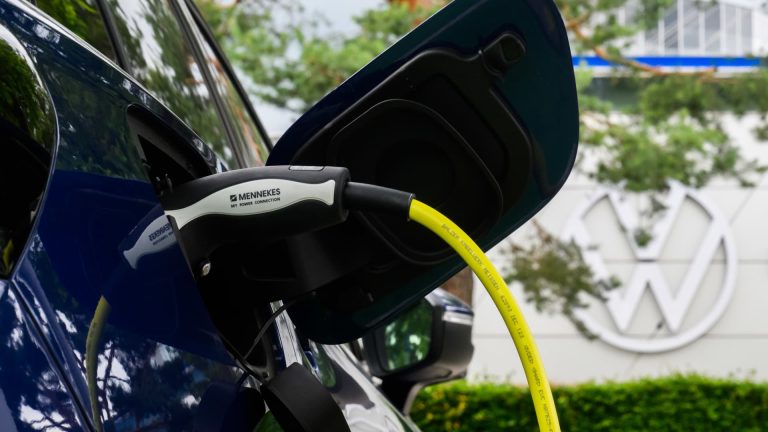
A Volkswagen ID4 electrical automotive prices at a charging station in a car parking zone at Autostadt Wolfsburg. Volkswagen AG invitations its shareholders to the Annual Basic Assembly.
Image Alliance | Image Alliance | Getty Photos
Requested on Monday whether or not a few of these trade challenges have been more likely to dis-incentivize folks from shopping for EVs, Urquhart replied: “Nicely, I imply that is the purpose.”
“There appears to be a each day information cycle within the mainstream media of anti-BEV sentiment, a variety of it’s not particularly well researched … however a variety of it’s true,” Urquhart mentioned.
“Customers are going through a really, very troublesome selection. They’ve had the identical expertise paradigm within the trade for 130 years, and we’re asking shoppers to fully change the way in which they drive their autos, use their autos, cost their autos as an alternative of filling them with petrol,” he continued.
“I believe there was a type of collective over-enthusiasm from regulators, [original equipment manufacturers], possibly from our aspect as nicely in some respects, for BEVs. Not likely understanding it’s a very, very laborious promote to get most mainstream shoppers to fully change the way in which they use and function their autos.”
‘A non-linear journey’
Analysts, nonetheless, have made clear that regardless of the short-term uncertainties, carmakers notice they can’t afford to overlook out on EVs — and the course of journey stays clear.
“The shift to EVs is a non-linear journey with many uncertainties, as now we have seen during the last couple of years. Nevertheless it’s more and more placing European carmakers beneath strain, whereas whole new automotive gross sales fail to return to pre-pandemic ranges of their house markets,” Rico Luman, senior sector economist for transport and logistics at Dutch financial institution ING, said in a current analysis be aware.

Luman mentioned the choice from some European carmakers to delay the shift to EVs is “very a lot meant to take care of profitability and protect flexibility in a extremely unsure surroundings.”
He added that the slowdown in Western EV gross sales was owed to a number of causes and was more likely to be momentary.
“The course of journey has not modified, and investments within the makeover of product portfolios nonetheless have to proceed to safe long-term positions available in the market over the subsequent decade,” Luman mentioned in a be aware revealed on Sept. 6.
[ad_2]
Source link