[ad_1]
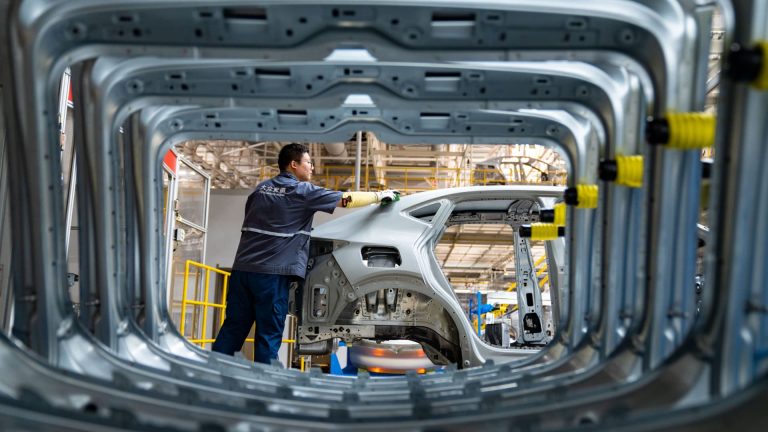
Staff producing pure electrical autos at a Volkswagen (Anhui) workshop in Hefei, China, on Sept. 25, 2024.
Cfoto | Future Publishing | Getty Photos
Europe’s prime automotive giants seem like more and more involved in regards to the prospect of huge fines, notably as electrical car demand falters forward of the subsequent tightening of carbon rules.
Automakers working in Europe face stricter emission targets from subsequent yr because the EU cap on common emissions from new autos gross sales falls to 93.6 grams of CO2 per kilometer (g/km), reflecting a 15% lower from a 2021 baseline of 110.1 g/km.
Exceeding these limits — which have been agreed in 2019 and kind a part of the 27-nation bloc’s ambition to achieve climate neutrality by 2050 — may end up in hefty fines.
Rico Luman, senior sector economist for transport and logistics at Dutch financial institution ING, stated Europe’s carmakers had each motive to be involved in regards to the scale of the monetary penalties.
“The fines are huge truly. Whenever you calculate it … it simply involves many thousands and thousands primarily based on the volumes they produce,” Luman advised CNBC by way of videoconference.
Renault CEO Luca de Meo stated final month that if EV gross sales stay at present ranges, the European auto {industry} could need to pay 15 billion euros ($16.5 billion) in monetary penalties or quit the manufacturing of over 2.5 million autos, Reuters reported, citing an interview with French radio.

The European Vehicle Producers’ Affiliation, or ACEA, says the {industry} is lacking “essential situations” to assist the zero-emission transition, “with issues about assembly the 2025 CO2 emission discount targets for vehicles and vans on the rise.”
The automotive foyer group, which represents the likes of BMW, Ferrari, Renault, Volkswagen and Volvo, warned that the EU’s present guidelines “don’t account for the profound shift within the geopolitical and financial local weather” lately.
“European auto producers, united in ACEA, subsequently name on the EU establishments to come back ahead with pressing reduction measures earlier than new CO2 targets for vehicles and vans come into impact in 2025,” ACEA stated in a press release printed Sept. 19.
Tim McPhie, a spokesperson for the European Fee, the EU’s govt arm, said in a press briefing late final month that the auto {industry} nonetheless has 15 months to satisfy the brand new targets, including it’s “too quickly to invest” on the dimensions of the potential fines.
“We have now designed these insurance policies in a method that the {industry} has time to adapt, that the general financial ecosystem has time to adapt however, after all, we’re delicate to the challenges which can be being confronted,” McPhie stated on Sept. 24.
‘A large battle’
Europe’s prime automakers are contending with a perfect storm of challenges on the trail to full electrification, together with a scarcity of inexpensive fashions, a slower-than-anticipated rollout of charging factors and the potential affect of European tariffs on EVs made in China.
Crisis-stricken Volkswagen and several other different carmakers, together with Ford and Mercedes-Benz Group, have all announced plans to delay earlier targets to section out gross sales of inner combustion engine (ICE) autos in Europe.
“Producers are just about targeted on typical hybrids and ICE autos as a result of they’re much extra worthwhile,” ING’s Luman stated.
“In the long term, they should compete with the brand new gamers and restructure their organizations by making the shift to the transition however that is not that worthwhile within the quick run,” he continued. “So, that is an enormous battle.”
An EnBW electrical automotive charging station close to Weissenfels, Germany.
Sean Gallup | Getty Photos Information | Getty Photos
The ACEA says that the EU’s battery electrical market share has fallen to 12.6% this yr, down from 13.9% in 2023, whereas the bloc’s automotive gross sales stay round 18% decrease than pre-pandemic ranges in 2019.
Xavier Demeulenaere, affiliate director of sustainable mobility at S&P World Mobility, stated all of Europe’s unique gear producers (OEMs) have a “robust incentive” to spice up their very own EV gross sales to decrease their common fleet emissions and adjust to the regulated goal.
“The slowdown in electrification we’re seeing in 2024, as a result of a worsening financial state of affairs throughout Europe and the elimination or discount of subsidies in some international locations, makes the state of affairs difficult for many OEMs because it creates a requirement difficulty,” Demeulenaere advised CNBC by way of phone.
“But when demand just isn’t there, pooling stays one of many essential mechanisms to mitigate as soon as once more these potential monetary penalties which can be anticipated in 2025,” he added.
Pooling refers back to the course of through which automotive producers staff as much as be thought of as one entity when calculating their efficiency in opposition to a CO2 emissions goal.
Disaster? What disaster?
Not everyone seems to be satisfied that the gross sales problem that Europe’s automotive {industry} faces constitutes an industry-wide disaster.
Marketing campaign group Transport & Setting said in an evaluation printed Wednesday that the present state of play ought to as an alternative be thought of a “transitional section” through which producers adapt to new rules and altering EV market dynamics.
The Volvo Vehicles Hill Nation dealership on in Austin, Texas.
Brandon Bell | Getty Photos Information | Getty Photos
Analysts at Transport & Setting stated the European automotive {industry} has had since 2019 to plan for subsequent yr’s CO2 goal and producers can keep away from having to pay massive fines by promoting extra hybrids and extra fuel-efficient vehicles.
“Carmakers additionally profit from flexibilities within the regulation that additional (artificially) decrease their CO2 emissions, in addition to the choice to pool their emissions with different carmakers,” they added.
“The worthwhile European carmakers could have to promote fewer huge polluting SUVs, however then that’s the intention of the automotive CO2 regulation.”
Highway transport is the main contributor to move emissions of CO2 within the EU, with passenger vehicles and light-weight business autos accounting for practically 15% of complete emissions.
[ad_2]
Source link