[ad_1]
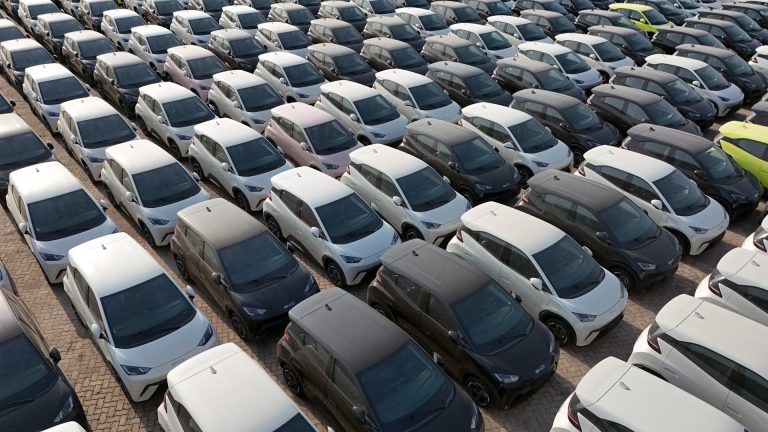
An aerial view of recent BYD electrical vehicles to be exported on a dock in Yantai in east China’s Shandong province.
Tang Ke | Future Publishing | Getty Photographs
The Chinese language authorities on Wednesday hit out on the European Union over tariffs on electrical automobile imports, after the bloc lowered duties on a number of main electrical automakers, together with Tesla.
A Ministry of Commerce spokesperson informed reporters that Beijing continues to consider that the EU’s probe into China’s subsidies for its electrical automobile trade have come to “pre-set conclusions,” including that the bloc is selling unfair competitors.
“China will take all essential measures to resolutely defend the professional rights and pursuits of Chinese language firms,” the Ministry of Commerce spokesperson mentioned, in response to a Google translation.
On Tuesday, the European Fee, the EU’s govt physique, lowered import duties on a variety of electrical automobile producers importing vehicles into the EU from China.
It additionally set tariffs on Elon Musk’s electrical automobile maker Tesla at 9%, under a beforehand anticipated 20.8% fee.
These tariffs come on prime of current EU duties of 10% on battery electrical automobiles imported into the area from China.
The Fee additionally lowered tariffs on a number of Chinese language electrical automotive makers, together with BYD, SAIC, and Geely.
The tariffs, first introduced by the EU in June, are available response to considerations from the bloc that beneficiant subsidies of China’s electrical automobile trade are distorting competitors in Europe.
In response to the transfer, the Chinese language Commerce Ministry mentioned that each the federal government and China’s EV trade offered “tens of 1000’s of pages of authorized paperwork and proof supplies by way of numerous means akin to submitting questionnaires, written feedback, and listening to statements.”
These paperwork, the Ministry mentioned, “have comprehensively and deeply defended the unreasonable and non-compliant practices of the EU,” and highlighted how EU tariffs “will disrupt the soundness of the worldwide automotive trade chain provide chain together with the EU.”
The EU’s ultimate ruling, the Ministry mentioned, “didn’t totally take up China’s opinions” and was “based mostly on the ‘information’ unilaterally recognized by the EU, reasonably than the information acknowledged by each events.”
“China firmly opposes and is very involved about this,” the Ministry mentioned.
It added that it hopes to resolve any commerce disputes with the EU and to take sensible actions to keep away from an escalation of commerce frictions.
[ad_2]
Source link