[ad_1]
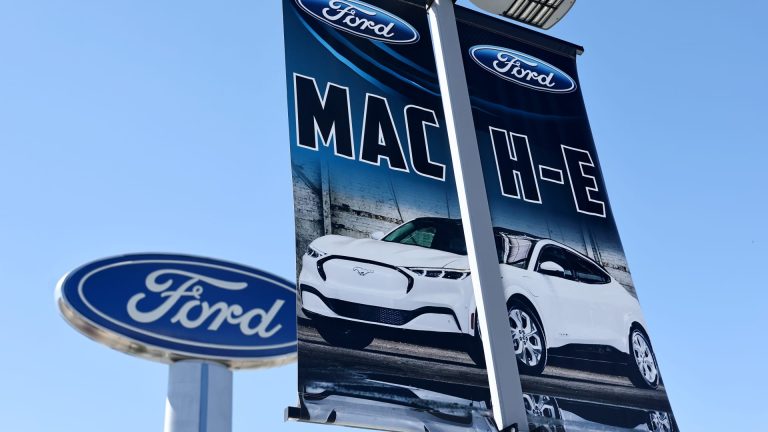
A banner advertises the Ford Mustang Mach-E electrical car at a Ford dealership on August 21, 2024 in Glendale, California.
Mario Tama | Getty Photographs
DETROIT – Ford Motor‘s revenue engine for many years has been massive vehicles and SUVs within the U.S. So it would shock traders that the automaker believes its new path to profitability for electrical automobiles will first be led by smaller, extra inexpensive automobiles.
The brand new plan is an “insurance coverage coverage” for the automaker to have the ability to broaden its growingly in style hybrid fashions and create extra inexpensive EVs that it believes will ship a extra capital-efficient, worthwhile electrical car enterprise for the corporate and traders, in line with Marin Gjaja, Ford’s chief working officer for its Mannequin e EV unit.
“We’re fairly satisfied that the best adoption charges for electrical automobiles will likely be within the inexpensive section on the decrease size-end of the vary,” he instructed CNBC on Thursday. “We’ve got to play there with a purpose to compete with the entrants which can be coming.”
These anticipated newcomers are largely Chinese language automakers, resembling Warren Buffett-backed BYD, which have been quickly rising from their dwelling market to Europe and different international locations.
Gjaja’s feedback got here a day after the automaker introduced updates to its EV strategy that will cost as much as $1.9 billion. That features about $400 million for the write-down of producing belongings, in addition to further bills and money expenditures of as much as $1.5 billion.

Ford, Tesla and GM shares
Ford’s new plans for North America embrace canceling a big, electrical three-row SUV that was already far in improvement, delaying manufacturing of its next-generation “T3” electrical full-size pickup truck by about 18 months till late 2027, and refocusing battery manufacturing and sourcing to the U.S.
As an alternative of the three-row SUV or massive pickup, the corporate’s first new EV is predicted to be a industrial van in 2026, adopted the subsequent 12 months by a midsized pickup after which the T3 full-size pickup.
Gjaja stated the choice wasn’t taken frivolously, particularly the cancellation of the upcoming three-row vehicle, which Ford CEO Jim Farley and different executives had been touting as a recreation changer for a number of years.
The industrial van comes as Ford’s “Pro” commercial vehicle and fleet business, which incorporates vans and enormous Tremendous Responsibility vehicles, has been a standout for the corporate and offset billions of {dollars} in EV losses.
And the midsize pickup is scheduled to be the primary car from a specialized “skunkworks” team in California, The corporate had tasked the crew two years in the past with creating a brand new small EV platform.
“We imagine smaller, extra inexpensive automobiles are the way in which to go for EV in quantity. Why? As a result of the mathematics is totally completely different than [internal combustion engine (ICE) vehicles],” Farley instructed traders final month. “In ICE, a enterprise we have been in for 120 years, the larger the car, the upper the margin. But it surely’s precisely the other for EVs.”
Farley has stated the burden and price of battery packs wanted for giant automobiles resembling a three-row SUV, which many households purchase for street journeys, towing and hauling, are a limitation for EVs as a consequence of present ranges and charging networks.
Ford’s present EVs — the Mustang Mach-E crossover, F-150 Lightning and a industrial van within the U.S. – usually are not worthwhile general. The Mannequin e operations have misplaced almost $2.5 billion through the first half of this 12 months and misplaced $4.7 billion in 2023.
The losses, in addition to altering market circumstances and enterprise plans, brought about Ford earlier this year to withdraw an formidable 8% profit margin for its EV unit by 2026.
Traders and Wall Avenue analysts have largely supported the EV modifications, most not too long ago sending the corporate’s shares up about 2.3% because the announcement earlier this week, regardless of the anticipated prices.
“General, these modifications will place Ford to profit from rising demand for EVs, whereas additionally specializing in areas through which it has a Core aggressive benefit,” BofA’s John Murphy wrote Wednesday in an investor be aware. “Given the dimensions of the cost, that is clearly a troublesome determination within the short-term, however we predict is smart within the medium to long-term given what is going to seemingly be subpar economics within the three-row CUV/SUV section.”
Extra hybrids, fewer EVs
The updates are the newest for Ford’s electrification plans, which now embrace a heavy deal with hybrid and plug-in hybrid electrical automobiles, or PHEVs, to help in assembly tightening gas economic system laws along with all-electric automobiles.
Ford CFO John Lawler stated Wednesday that the corporate’s future capital expenditure plans will shift from spending about 40% on all-electric automobiles to spending 30%. He didn’t give a timeline for the change, but it surely’s a large swing from when the corporate introduced plans in 2021 to spend greater than $30 billion on EVs via 2025.
The hybrid plans embrace providing such choices throughout its complete North American lineup by 2030, together with three-row SUVs, to help in assembly tightening emissions and gas economic system necessities. Lawler stated that to enhance profitability, Ford can be accelerating the combo of battery manufacturing within the U.S. that may qualify for tax incentives and credit.
A Ford F-150 Lariat PowerBoost hybrid pickup truck is displayed on the market at a Ford dealership on August 21, 2024 in Glendale, California.
Mario Tama | Getty Photographs
The shift in Ford’s plans is according to the general auto business, which is dealing with rising, however slower-than-expected adoption of EVs, in addition to automakers not having the ability to obtain anticipated profitability on the automobiles.
“What we noticed in ’21 and ’22 was a short lived market spike the place the demand for EVs actually took off,” Gjaja instructed CNBC throughout an interview earlier this 12 months. “It is nonetheless rising however not almost on the price we thought it may need in ’21, ’22.”
There’s additionally an industrywide concern that Chinese language automakers may have the ability to flood markets with cheaper, extra worthwhile EVs. Chinese language automakers resembling BYD are shortly rising exports of automobiles to Europe and different international locations.
Lawler pushed again Wednesday on the concept the Chinese language have outgunned American automakers. He stated the Ford, partly, developed the skunkworks crew to show that Ford can compete towards the Chinese language automakers.
“As we have watched within the final 18 to 24 months, the emergence of unimaginable merchandise and formidable rivals in China has actually been, I feel, the story for us,” Gjaja stated. “And so now, once we take a look at the aggressive panorama, now we have to chin ourselves towards essentially the most aggressive corporations in China.”
Ford vs. GM
Ford’s new plans are polar reverse of its closest rival, General Motors.
America’s largest automaker has pulled again spending and delayed many of its EVs, but it surely has a number of large all-electric vehicles on sale coming quickly.
GM was among the many first to go “all in” on EVs, together with by making a vertically built-in, devoted electrical car platform and supporting applied sciences resembling batteries and motors.
2025 Cadillac Escalade IQ
Michael Wayland / CNBC
Except for Tesla, GM was the primary automaker to start U.S. battery cell manufacturing via a three way partnership at scale, which the corporate has continued to tout as a price benefit
GM’s present lineup consists of three all-electric massive pickup vehicles, a Hummer SUV, two not too long ago launched Chevrolet crossovers, a luxurious Cadillac crossover and $300,000 Celestiq automobile. A number of extra crossover fashions and an all-electric Escalade SUV are anticipated to hitch the lineup this 12 months as properly.
As not too long ago as final month, GM reconfirmed expectations for its EVs to be worthwhile on a manufacturing, or contribution-margin foundation, as soon as it reaches output of 200,000 models by the fourth quarter.
A GM spokesman Thursday stated the automaker continues “to work to succeed in variable revenue constructive through the fourth quarter.”
Gjaja declined to touch upon GM’s goal or operations however stated Ford is doing what’s finest for the corporate.
“We’re specializing in what we predict are the suitable applied sciences to serve our prospects that can be inexpensive for them and worthwhile for us,” he stated.
[ad_2]
Source link