


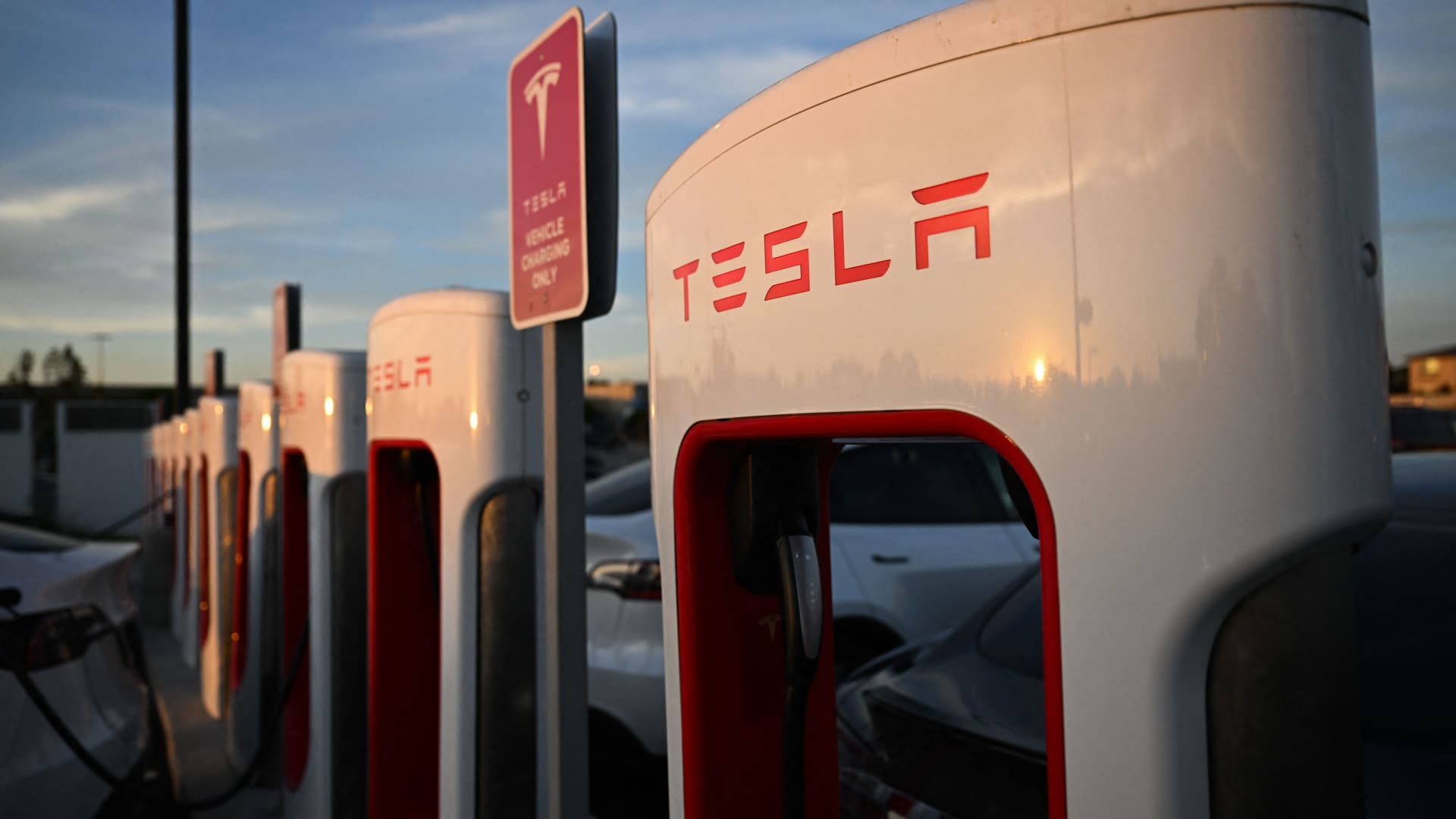
The Biden administration desires to see at the very least 500,000 electrical car chargers on US roads by 2030, and introduced a slate of initiatives on Wednesday to assist make {that a} actuality, together with commitments from corporations that construct and function charging networks like Tesla, GM, Ford, ChargePoint and others.
The entire corporations stand to reap the advantages of federal funding if their deliberate charging infrastructure tasks meet new federal requirements, which had been additionally revealed on Wednesday.
As a part of this effort, White Home officers mentioned, they locked a dedication from Tesla to open 1000’s of its chargers to electrical automobiles made by different producers. Till now within the US, Tesla Supercharging stations have been accessible primarily to drivers of the corporate’s personal automobiles.
Tesla particularly agreed to make at the very least 7,500 of its publicly accessible chargers within the US obtainable to be used by any suitable EV by the top of 2024. That complete will embody at the very least 3,500 of Tesla’s 250-kilowatt Superchargers positioned alongside key freeway corridors, in addition to the slower Stage 2 vacation spot chargers that the automaker offers at places like lodges and eating places, the officers mentioned.
Tesla additionally agreed to triple the variety of Superchargers in its U.S. community, with new chargers that might be made in Buffalo, NY, the official mentioned. The corporate has been assembling a few of its charging gear at a facility in Buffalo that was initially meant as a photo voltaic panel manufacturing unit.
Tesla has meant to open up its charging community within the US for years. Based on Tesla’s most up-to-date annual financial filing, in November 2021 the corporate “started to supply Supercharger entry to non-Tesla automobiles in sure places in help of our mission to speed up the world’s transition to sustainable power.”
White Home infrastructure chief Mitch Landrieu informed reporters on Tuesday that Musk was one among many automotive sector CEOs concerned in discussions with the White Home about charging infrastructure final yr.
“He was very open, he was very constructive,” Landrieu mentioned. “And at the moment, he mentioned his intent was to work with us to make his community interoperable. Everyone else on the decision agreed.”
Landrieu added, “It was critically essential to us that everyone be included within the dialog.”
The White Home additionally lauded different automakers and corporations, praising a separate deal between General Motors, Pilot Firm, and charging community EVGo to put in 2,000 fast chargers at Pilot and Flying J centers alongside U.S. highways.
GM by way of a separate partnership with FLO, additionally plans to put in as much as 40,000 public Stage 2 EV chargers in US communities by 2026, which is able to grow to be a part of GM’s Ultium Cost 360 community, and be obtainable to all EV drivers.
Ford has dedicated to putting in DC Quick chargers at 1,920 of the corporate’s dealerships by January 2024.
Hertz and oil large BP‘s EV charging unit plan to install thousands of chargers in main U.S. cities to be used by Hertz prospects and most of the people.
Amongst Wednesday’s bulletins, the Departments of Vitality and Transportation additionally revealed new charging requirements that “guarantee everybody can use the community – it doesn’t matter what automobile you drive or what state you cost in.” Among the many necessities:
- All new chargers constructed with federal funds should help the Mixed Charging System (CCS) plug customary. The CCS customary is utilized by most automakers aside from Tesla.
- New charging websites constructed with federal funds might be required to have a minimal variety of DC Quick chargers.
- Federally funded chargers have to be up and operating at the very least 97% of the time as soon as put in.
- Efficient instantly, all federally-funded chargers have to be assembled within the U.S., and their metal enclosures have to be made within the U.S. By July 2024, at the very least 55% of the chargers’ parts (measured by price) have to be made within the U.S. as properly.
- New chargers constructed with federal funds to be suitable with new user-friendly applied sciences like “Plug and Cost”, which – because the identify suggests — automates the method of paying for the cost.
There are additionally new guidelines to assist make sure that drivers haven’t got to make use of a number of apps to search out and use chargers, by making knowledge on charger places, pricing, and availability public and obtainable by way of mapping functions.
However in a single omission that can elevate questions from staunch environmentalists, the brand new federally funded EV chargers is not going to essentially be powered by clear power sources.
Officers mentioned it will likely be “firm dependent” whether or not EV chargers which are federally funded are powered by renewables or “clear electrical energy,” or just related to the prevailing electrical grid.
Transportation has been liable for 25% of carbon emissions from human exercise globally, in line with estimates by the non-profit Worldwide Council on Clear Transportation. A lot of that air pollution comes from tailpipe emissions, however charging with electrical energy from clear or renewable sources will increase the local weather advantages of switching to an electrical car.
Based on environmental affect analysis by Mission Drawdown, in comparison with gasoline-powered automobiles, emissions drop by 50% when an electrical car’s energy is drawn from the traditional grid. When powered by photo voltaic power, carbon dioxide emissions from an electrical car fall by 95% versus a comparable inside combustion engine car that burns gasoline.
Officers did counsel it is going to all work out in the long term, nevertheless. Through the briefing, Vitality Secretary Jennifer Granholm emphasised that the President’s purpose is to get to a “totally clear electrical grid” by 2035.